A translated product title can be fluent while its specifications remain ambiguous. A model code may have changed case, a quantity may refer to a pack rather than one item, and a size may belong to a different selected variant. Reading the page as a single paragraph makes these differences easy to miss.
A more dependable approach separates the listing into fields before comparing it with another page. Preserve identifiers and numbers, translate explanatory language, and keep uncertainty attached to the field that caused it. The method works for ordinary household goods and becomes especially useful when reading technical ingredient information.
Capture the selected variant before translating
A listing can present several options under one title. Colour, size, material and pack count may change when a different option is selected. Record the selected option alongside the title instead of assuming the main photograph describes every variant.
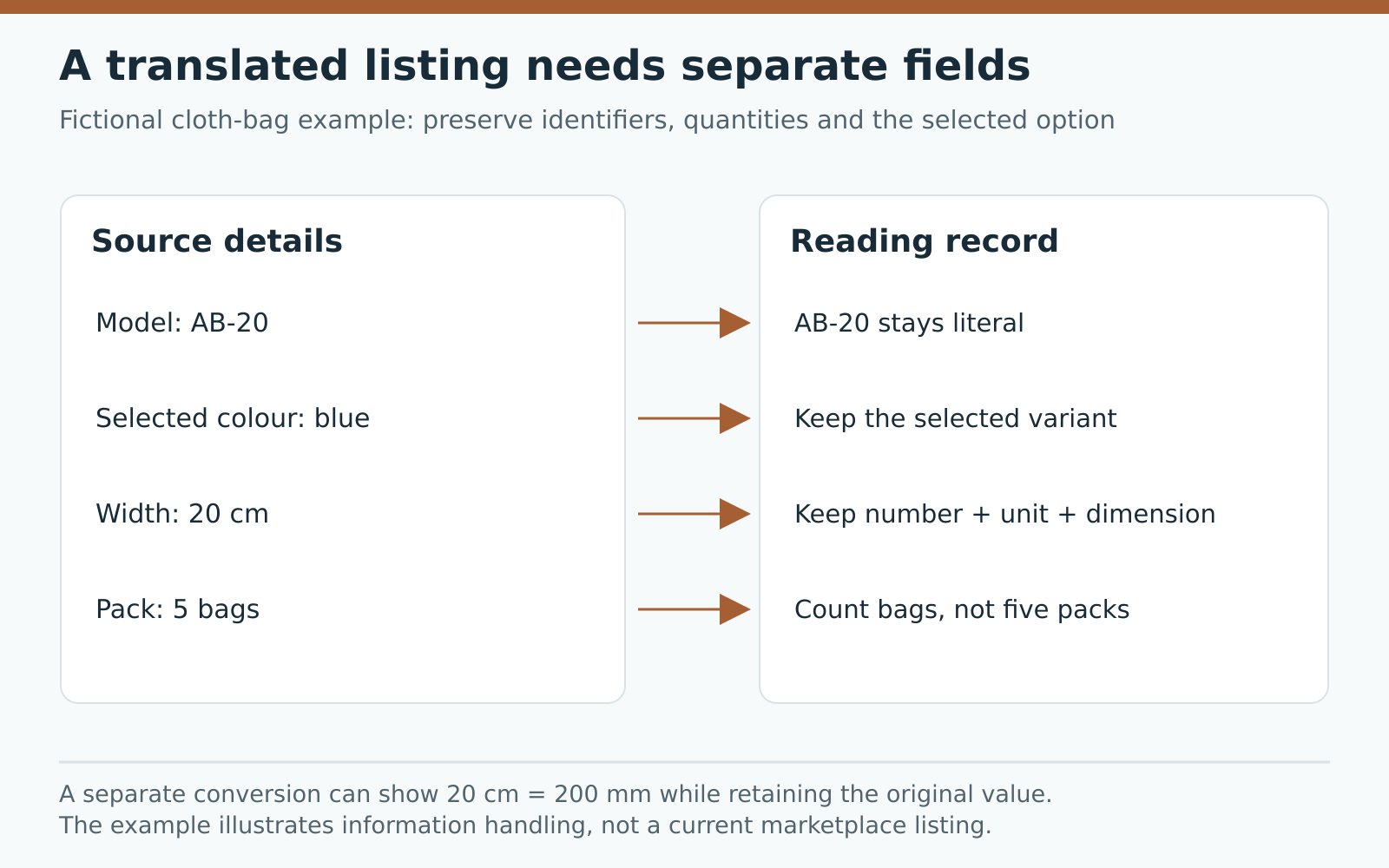
Use a fictional cloth-bag example: the page title describes a storage bag, while the selected option is blue, model AB-20, width 20 cm, pack of five. Another option may use the same photograph but have a different width or quantity. A translated title alone cannot distinguish them.
For a reading worksheet, make separate rows for title, model, selected colour, dimensions and package quantity. Leave a field blank when the source does not provide it. An empty field is more honest than a detail inferred from a neighbouring option.
Protect codes from helpful-looking translation
Model identifiers are labels, not ordinary prose. AB-20, Ab20 and AB-20B may refer to different items. Preserve their characters, punctuation and capitalization as shown, even if a translation tool offers a smoother-looking version.
The W3C explanation of HTML’s translate attribute describes how page authors can mark content that should remain untranslated. This is relevant to codes, interface labels and other text whose literal form matters. It does not guarantee that every external listing or translation tool will preserve those fields correctly.
For a reader, the practical implication is to compare important identifiers with the original page. A translated display is a reading aid, not a replacement for the source characters in a technical record.
Separate the number from the thing it counts
The number five could describe five items, five pairs or five packs. A width of 20 cm describes a dimension, not necessarily a capacity or a size category. The noun and unit belong to the value.
| Fictional source field | Preserve in the reading record |
|---|---|
| Model AB-20 | The literal identifier AB-20 |
| Width 20 cm | The value, unit and dimension name |
| Pack of 5 | What the pack contains and how many |
| Blue option selected | The chosen variant, not all available colours |
Common Chinese field labels can help locate information: 颜色 commonly labels colour, 数量 quantity, and 规格 a specification or variant description. Their meaning still depends on the surrounding text. A field labelled specification may combine several attributes rather than supply one standardized measurement.
Keep a source value beside any conversion
The NIST guide to expressing quantity values explains the relationship between numerical values and units. In a comparison worksheet, that relationship should remain visible instead of being reduced to a bare number.
If a dimension is converted, retain the original value and unit in one column and the converted result in another. This makes a decimal-place or unit error easier to find. Do not overwrite the source measurement with a rounded conversion and then treat the rounded figure as the original specification.
For example, a fictional listing giving 20 cm can be recorded as 20 cm, with 200 mm in a separate conversion column. The conversion changes the numerical expression, not the physical dimension. It does not establish that the listed measurement was accurate in the first place.
Distinguish label text from an inference
A photograph may suggest that a container is large, but perspective does not provide a reliable measurement. A familiar-looking material may suggest cotton, but appearance does not establish composition. Record those impressions as impressions, not as fields supplied by the listing.
A useful three-column note contains original text, translated meaning and unresolved question. If the original does not specify whether a dimension includes a handle, put that uncertainty in the third column. Translating the words more elegantly will not resolve information that was absent.
This habit is especially helpful when a title uses broad promotional adjectives. The factual specification can remain concise while the marketing description is kept separate.
Compare like with like across two pages
Suppose two fictional bags are both described as medium. One page provides width and height, while the other gives only a capacity. Those fields do not establish equal dimensions. A side-by-side comparison should preserve the mismatch rather than force both products into one size column.
The same applies to a pack price versus a single-item price. Before comparing numbers, establish the unit being counted. A page may also display a range spanning several variants, so the selected option must remain attached to the value under discussion.
The goal here is information clarity, not a purchasing recommendation. A clean comparison can reveal that the available descriptions are insufficient to answer a question.
Save the context of an image-based specification as well. If a size chart appears only inside a photograph, text translation may not include it or may interpret its columns incorrectly. A manual note can retain the original row and column headings. If a measurement’s orientation remains unclear, record that uncertainty instead of selecting whichever interpretation makes two listings appear comparable.
Carry the method into scientific ingredient reading
Technical ingredient names introduce additional identifiers, including registry numbers, chemical forms and sequence notation. Those fields deserve the same literal preservation as a model code. A familiar translated name may conceal differences between a salt, a modified molecule or a mixture.
Begin with the small discipline established by the cloth-bag example: retain the original identifier, define each quantity and record the selected form. Later chemical questions become easier when the underlying text has not already been simplified beyond recognition.
A successful translation record is not merely readable English. It lets another reader trace a statement back to the exact field that supports it, identify which variant was selected and see which questions the source leaves unanswered.